
洛丽塔
按场景选配置,养AI龙虾不同用途需要什么档次的服务器_我的网站

一 |
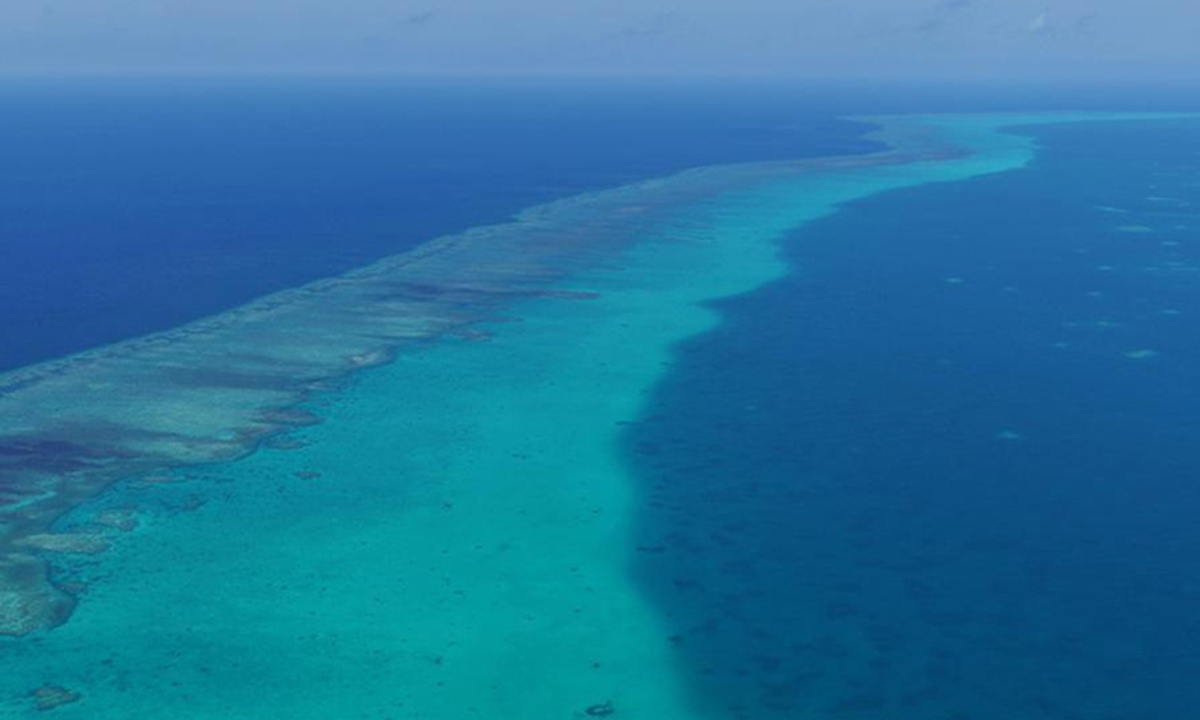
Amid a new round of Philippine hype over its so-called territorial claims involving China's Huangyan Dao, the US State Department on Saturday, in a statement, smeared China's Huangyan Dao National Nature Reserve as "destabilizing" and pledged support for its ally. A Chinese expert said Washington is encouraging Manila to disrupt regional peace while offering little more than hollow verbal assurances, further undermining stability in the South China Sea.
The statement, published on the State Department's official website and attributed to spokesperson Thomas Pigott, claimed that the US "rejects China's ongoing attempts to enforce its destabilizing 'national nature reserve'" at Huangyan Dao.
Pigott also alleged that the reserve would "deny Filipino fishermen access to their traditional fishing ground as reflected in the 2016 Arbitral Award."
It is absurd for the US, a country that is not a party to the United Nations Convention on the Law of the Sea (UNCLOS), to pass judgment on the Huangyan Dao National Nature Reserve, Yang Xiao, a research fellow at the Institute of Peaceful Development under the Chinese Academy of Social Sciences, told the Global Times on Sunday.
The US has neither jurisdiction in the South China Sea nor the standing to judge regional affairs. Its allegation of the reserve at this time is merely intended to echo the Philippines' latest hype surrounding Huangyan Dao, Yang said.
At a time when the broader China-US relationship is moving toward an easing of tensions, attempts by certain US officials to encourage provocations out of narrow political interests run counter to the overall trend, Yang said.
Pigott further smeared the reserve as "another unilateral attempt by China to use dubious environmental and legal pretexts," which he claimed was intended to advance China's territorial and maritime claims in the South China Sea "at the expense of its neighbors."
"The United States stands with our Ally, the Philippines, in support of a free and open Indo-Pacific," Pigott claimed.
The expert added that the statement also invoked the unlawful and invalid 2016 "South China Sea Arbitral Award" as a pretext, seeking to portray China as a destabilizing force in the region and mislead the international community.
The US statement comes as Manila has sought to advance its claims over Huangyan Dao through various means, including by delimitation of the so-called "baselines of the territorial sea" of the Chinese territory of Huangyan Dao. The Chinese Foreign Ministry on July 31 described the move as "illegal, null and void."
Yang said that amid a broader retrenchment of its global strategy, the US is seeking to encourage countries including Japan and the Philippines to stage regional provocations and disrupt stability. Such tactics include organizing joint military exercises and tolerating provocative actions by Manila in the South China Sea.
However, Washington is no longer capable of offering the Philippines substantive support and can provide little more than rhetorical backing, Yang said. Such statements amount to words on paper and have no practical effect, he added.
China's State Council approved the establishment of the Huangyan Dao National Nature Reserve in September 2025. China has since conducted multiple scientific surveys in the area.
On August 1, China issued management measures for the reserve, prohibiting unauthorized fishing and mining, the harvesting or excavation of corals, coral reefs and giant clams, as well as other activities that damage rare marine species or the reserve's natural ecosystems.
China has also discovered a globally rare coral reef growth structure-type marine blue hole at Huangyan Dao. Preliminary geochronological analyses suggest that the blue hole formed at least 3,200 years ago, while surveys have found rich biodiversity in its surrounding waters. The finding is considered further evidence of the effectiveness and necessity of China's ecological protection measures at Huangyan Dao.
。
一键部署OpenClaw 选好了服务商,接下来就是选配置。这一篇帮你搞清楚:不同用途到底需要多强的服务器。

二 | OpenClaw对硬件的基本要求其实不算高。最低配置是2核CPU + 2GB内存 + 40GB SSD存储,就能让一个基础版的OpenClaw跑起来。但注意,这个“跑起来”指的是最精简的文字对话模式——没有网页浏览、没有多任务并发、没有浏览器自动化。 一旦你开启了更复杂的功能,资源需求会迅速增加。尤其是浏览器自动化功能(通过Chromium操作网页),每开一个会话就可能吃掉2GB到4GB的内存。 具体怎么选?我们按使用场景来分: 轻度场景(个人聊天助手) :配置2核4GB内存、50GB系统盘就够用了。适合接入微信、飞书或Telegram,日常回消息、查资料、记笔记,偶尔跑一跑定时任务。建议选4GB内存,比2GB从容很多。

三 | 中度场景(多Agent协作 + 浏览器自动化) :需要4核8GB内存起步。这种配置能同时运行多个Agent,每个Agent可以独立处理不同任务,或者用浏览器自动化完成爬数据、填表单、订票等操作。

四 | OpenClaw的多Agent协作机制让多个“龙虾”分工干活,但每个Agent都会占用资源,内存不够就容易卡顿甚至崩溃。 重度场景(企业级多用户并发) :如果你打算让团队一起用,或者要支撑大规模自动化流程,那就要上更高配置了。

五 | 比如浪潮信息元脑x86服务器实测发现,每个OpenClaw容器最低需要4vCPU + 4GB内存才能稳定运行。这台高密度算力服务器单机能跑96路Agent并发,但那是企业级的玩法,个人用户别冲动消费。 总结一下配置推荐表:
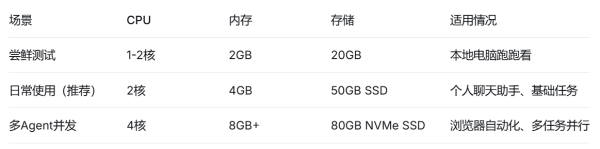 记住一个原则:内存永远不嫌多。OpenClaw的资源占用是动态的,刚启动时可能只占几百兆,跑起复杂任务来分分钟飙到好几GB。选择配置时,宁可贵一点买大内存,也别图便宜让服务器动不动就崩。
申请创业报道,分享创业好点子。点击此处,共同探讨创业新机遇!。
Current article:http://yzp0nn.pisezuibanzoukou.cyou/list_1p7w2/3peply6.html
Published on:19:31:40
我的女友是九尾狐_Random reading
- 08-22阶跃星辰,还是有点急了
- 08-25凯迪拉克全新 XT5 PHEV 将于 9 月 7 日上市,搭载 Momenta R7 世界模型
- 08-25上海永楚网络科技有限公司,莫名扣款给我退款
- 08-26आसाराम की जमानत याचिका खारिज, जोधपुर जेल में करना होगा सरेंडर
- 08-22山西:网传“太原暴雨已致3人遇难”为不实信息
- 08-20特斯拉向下,比亚迪向上
- 08-25投诉小米质量问题品控差
- 08-22【经开子语】—2025年寒假放假通知及致家长的一封信
- 08-21铜仁市人大常委会原党组书记胡洪成接受审查调查
- 08-22Trump Could Preempt ‘Bogus Findings’ of January 6 Hearing by Announcing 2024 Bid Early, Pundit Says

如果我爱你_Active users
- 同心同行——两岸青年交流季上海站活动在沪举行
- 一个华人家庭在美国“卷足球”:一年3万美元,每天300公里
- 大神集齐GBA全部791款游戏 合影太壮观价值一辆汽车
- S10就要来了!三星正式宣布银河新产品发布将于2月21日举行。
- 康盛人生:汲取宝贵教训 落实安全措施以符合监管要求
- 亚太经合组织第三次高官会“亚太合作能源角”系列活动成功举办
- B'desh tops apparel export growth to EU
- 高通骁龙8 Gen2现身跑分网站:CPU主频突破3.3GHz
- 华安证券:累计回购约2537万股
- Skycat ELF CC发布其第一款带屏幕的智能扬声器
- 河北五超·微视频|沧州队球员马越带伤重返赛场,全场高喊 "马越加油"
- 600亿牛股“六个核桃”,直线跌停
- PM to address 90th Interpol General Assembly on Tuesday
- 全国累计收购小麦超9000万吨
- 【套利】990!豆粕菜粕价差处于历史高位豆粕相对菜粕被高估
- 两名“老兵”二次入伍,选择去西藏戍边!
- 总理在今年第一次讲话中指明政府的方向:“要扭转混乱的局面”
- 2026年还有万元旗舰不能玩《原神》:谷歌PIxel 11系列GPU翻车
绅士的品格_Hottest this week
- 08-227月中国完成营业性货运量49亿吨,7月中国完成营业性货运量49亿吨
- 08-23扬科维奇提醒弟子:保持谦卑 末轮争胜
- 08-20【仓单】8月26日大商所苯乙烯期货仓单较上一日增长2000手
- 08-24United in Heart | Why is this entrepreneur from a century ago still remembered today?
- 08-25分析师称,iPhone 14 的预购情况比 iPhone 13 Mini 更糟糕_iPhone14ProMax成预售冠军_Plus
- 08-25内存危机冲击波持续,多款高端手机涨价超1000元
- 08-26産まれてすぐ看護師に「シュッとしててイケメン」と言われた息子。しかし、2年後の姿に「あれ?笑」「諦めないで!!」「珍しいパターン」
- 08-25中国人民银行将开展隔夜逆回购操作
- 洛丽塔 copyright
- Some of the content comes from the Internet. If you have any offence, please raise it.